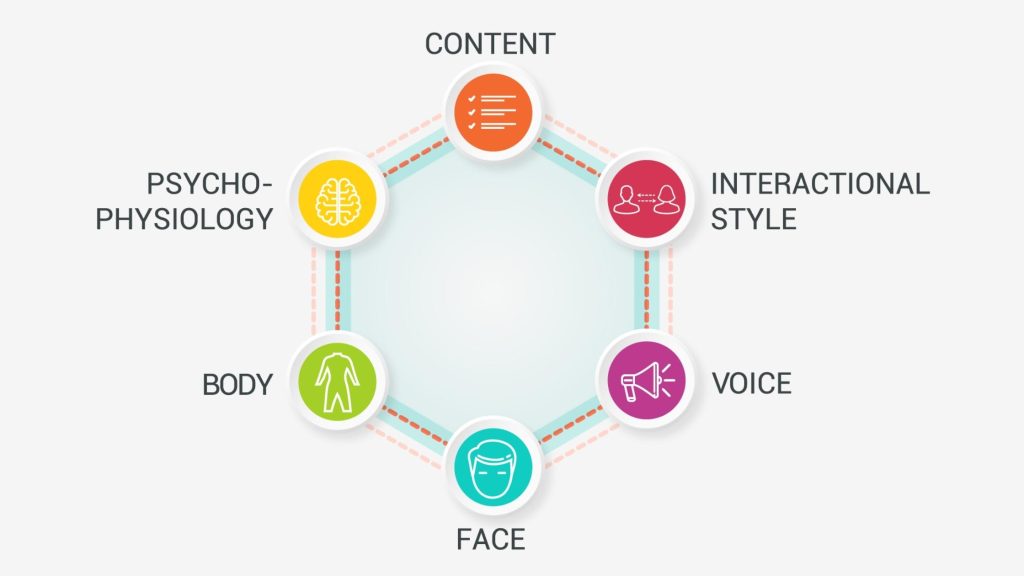
Six Channel Analysis System (SCAnS) is a scientifically supported behaviour analysis system pioneered by EIA Group (2008), designed to capture real-time behavioural data across all six communication channels:
- Voice
- Psychophysiology
- Facial Expressions
- Body Language
- Verbal Style
- Verbal Content
SCAnR
SCAnS is an extension of Six Channel Analysis in Realtime (SCAnR).
If a lie doesn’t evoke an emotional response in the liar, then the lie is unlikely to elicit behavioral changes (DePaulo et al., 1996). Such behavioural changes can be very useful when trying to catch a lie.
However, high-stakes deception or lies that cause arousal, or emotion, are more likely to create behavioural cues of deception. This is because the additional emotion (e.g., guilt) must be concealed through intentional effort in order to lie successfully. This effort to hide emotion often leaks through in someone’s verbal or non-verbal behaviour.
When using SCAnR, we are looking for changes among the six channels (made up of twenty-seven criteria linked to the six channels). These changes can point to inconsistencies within 1) the speaker's account (meaning the story they are trying to tell), 2) their baseline, and 3) the context. When such changes are seen trained SCAnR users are encouraged to code the inconsistencies as Points of Interest (Pins).
When we use SCAnR to code and analyse, it’s important to not draw any conclusions based on Pins alone. When analysing someone’s credibility it is best to look for clusters. This is because the Pins are only points of interest, worth looking into more. The term cluster refers to three or more Pins across two or more channels within seven seconds of a stimulus (such as when a question is asked). In general, Pins are not always associated with deception, they simply provide us with areas of interest or areas for ‘probing’ to further explore with targeted questions.
To communicate effectively and see through lies, it is important for us to have an accurate and high-quality understanding of systems like SCAnS and tools like SCAnR, so that we can read people and get to the truth in the real world in real-time.
Respecting Privacy
It is important, but complicated, to know how to respect the privacy and boundaries of someone that you are trying to understand, particularly when you look at all channels.
This is because there are the major issues of consent and privacy. You may notice an emotion through someone’s facial expressions or body language that they aren’t even aware that their feeling. In this way, understanding the six channels of communication can make interactions more difficult… if you can see through body language that someone is angry, and then ask why they’re angry, they may react defensively, especially if they haven’t taken time to self-reflect or accept that they are angry.
There are many reasons why someone might not be aware or accept their feelings, there may be shame related to certain emotions, such as anger or fear, or they may have a set idea of what they feel and how they should react. For example, believing that you’re happy for your ex to be moving on, and in denial about your true feelings.
When detecting deception in professional environments that require this skill, it’s very easy to apply these techniques, because that’s the job and that’s the point of the interaction. You’re there to catch a lie! Privacy and consent about you seeing the truth is not as much of a concern.
But when applying these techniques to daily life and your normal relationships, it does become a bit complicated. In general, usually once you learn these skills you can’t help but see the truth, even if someone doesn’t want you to, and even if they don’t know the truth themselves.
But through emotional intelligence and perfecting your communication skills, you can know when the appropriate times are to actually comment on what you’ve noticed.
Usually, it’s best not to mention things until someone else does, that way they are giving you a bid for connection and to talk about these aspects, making them feel more comfortable since it is ‘on their terms’.
For instance, if they say something like ‘I don’t know why I feel so off today’, this is a bid and in response you can gently express that you’ve noticed they seem a bit more anxious than usual.
Open ended questions are valuable tools in this regard. Let the person speak freely. Ask questions to understand, not to confirm an idea you have already.
This is a lot better than coming up with your own reasons of why someone might be feeling the way they are, because this risks bias. If you ask open-ended questions, you can then help someone else discover why they feel the way they feel, and it may very well be that they are able to find an answer that you would have never considered. You can also trust that this answer is accurate because they are the person feeling the emotions, not you.
Top Analysis Tips
In your communication with others, remember to be genuinely interested in what the other person is saying. Allow yourself to notice what you notice without pressure to decide what it means. Notice the flow of conversation, remembering that all question types are a form of controlling the conversation, even though some may seem more controlling than others.
Think about if you can give the other person the benefit of the doubt, even if you do see cues of deception. In general, it’s always best to assume that the other person is telling the truth (while still being aware of the risk of confirmation bias and protecting yourself from it).
Most importantly, assume that your presence needs to be accounted for, that you being in the interaction is influencing the interaction in some way.