

Boost EQ and build stronger relationships
Reading faces accurately is fundamental to emotional intelligence. See how others really feel, respond appropriately, and build deeper trust — personally and professionally.
Early bird 25% off EI2027 Book now →
Go beyond guesswork. Master the science of reading facial expressions, see the emotions people try to hide and boost your emotional intelligence — 100% online, at your own pace.
A misinterpreted smile can erode trust in an instant. Missing a fleeting micro-expression of fear can derail a critical negotiation. Taking politeness at face value leads to poor decisions in leadership and sales — and intuition alone often misses the real story written on someone’s face.
The Human Face closes that gap. Forget unreliable myths: the course is grounded in decades of scientific research, including Dr Paul Ekman’s Facial Action Coding System (FACS), and teaches you to systematically observe and accurately interpret the subtle muscle movements that reveal genuine emotion.
Accurate facial insight is a practical advantage in every conversation that matters.
Reading faces accurately is fundamental to emotional intelligence. See how others really feel, respond appropriately, and build deeper trust — personally and professionally.

Read your audience’s facial feedback in real time. Engaged, confused, sceptical? Adjust as you go for maximum impact and clarity — and become more aware of your own expressions.

Learn to catch micro-expressions — rapid, involuntary flashes of emotion that can contradict words or managed expressions. Not simplistic “lie spotting”, but finding the hot spots worth exploring.

Negotiate better, build a stronger leadership presence, hold more insightful sales conversations and make sharper recruitment decisions.
Five quick questions. No sign-up, and you’ll see the answers as you go.
Question 1 of 5
A fraction of a second. Micro-expressions are brief, involuntary flashes of emotion — often well under half a second, which is why most people miss them without training.
Question 2 of 5
Facial Action Coding System. Developed by Paul Ekman and Wallace Friesen, FACS describes every visible facial movement as a numbered “action unit”. It’s the system this course teaches you to use.
Question 3 of 5
The cheeks lift and the skin around the eyes crinkles. The muscle around the eye (orbicularis oculi) raises the cheeks and narrows the eyes. It’s a classic marker of enjoyment — though, like any single cue, not proof on its own.
Question 4 of 5
On its own, very little. No single behaviour reliably signals deception. Look for changes from someone’s baseline and clusters of cues, then use them to ask better questions.
Question 5 of 5
Seven. Anger, contempt, disgust, fear, happiness, sadness and surprise — recognised across cultures, and the starting point for reading any face.
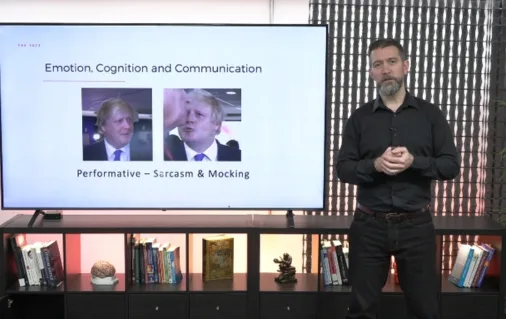
No prior knowledge needed — the course starts with the fundamentals of facial expression and the science behind it.
Build a trained eye for facial expressions. Learn what to look for, practise on real footage and check your observations — so you can bring greater attention and understanding to the conversations that matter.
Expert examples. A clear method. Practice you can check.
Watch an expert at work
Start with a real interview and an expert debrief. Compare what catches your attention with the facial movements the expert picks out, and begin to see where a closer look makes a difference.
Your takeaway
A clearer sense of where to focus your attention when someone’s expression changes.
Build your method
Learn how facial movements create the expressions you see. Use the Facial Action Coding System (FACS) to break them into recognisable parts, with demonstrations covering the brows, eyes, cheeks and mouth.
Your takeaway
A practical way to describe what changed, giving you a firmer starting point for understanding an expression.
Put the detail in perspective
Explore how facial analysis is applied, and what AI, animation and manipulated expressions mean for interpreting the faces we see on screen.
Your takeaway
A more questioning eye for what a facial expression — or a claim about it — can really tell you.
Practise, check and refine
Put your observation skills to work on real footage. Try the coding exercises and quizzes, then check the supplied answers to see what you spotted and where you need another look.
Your takeaway
A way to check your understanding and focus your practice as your eye for detail develops.
Start straight away, with lifetime access to revisit your learning.
The Discovery Channel’s Faking It shows behavioural analysis and facial decoding at work. Dr Cliff Lansley and Aaron Garner demonstrate how FACS-based principles uncover hidden emotions, interpret micro-expressions and read non-verbal cues in real-life situations.

Behavioural scientist
A pioneer in applying behavioural science, including FACS-based analysis, and featured on the Discovery Channel’s Faking It. Extensive experience training government, military and corporate clients worldwide.
LinkedIn: Dr Cliff Lansley (opens in a new tab) ↗
Communication & behaviour expert
An expert in communication and behaviour who integrates facial expression analysis into high-stakes training — from military and intelligence teams to negotiators and security personnel.
LinkedIn: Aaron Garner (opens in a new tab) ↗SCAnS® puts the face alongside body, voice, words, interaction style and psychophysiology. Take it further at your own pace, or live with expert coaching.
Build your foundation, at your own pace.
Apply the system with expert coaching.
From spotting cues to coding them - and reporting on them.
Teach SCAnS® in your own organisation or practice.
One payment, lifetime access. Start the moment you enrol and learn at your own pace.
Approx. $323 · €299
Fee indication only — the rate is set at the time of booking.
No. The course begins with the fundamentals of facial expressions and the science behind them.
Context is always key with human behaviour, but understanding universal expressions and micro-expressions, based on scientific research, significantly improves accuracy over guesswork or myths. This course teaches a reliable, evidence-based approach.
The face is one crucial channel within the broader SCAnS® framework. This course is a deep dive into facial analysis — it complements SCAnS® Online or stands alone as a powerful skill for emotional intelligence and communication.
Just a modern internet browser on a computer, tablet or smartphone.
For life. Your one-off payment gives lifetime access, so you can revisit lessons and the FACS cheat sheet whenever you need them.
Ready to start?
Enrol today and start your first lesson in minutes — or ask us anything about the course first.