


Step into the world of facial expressions, where every subtle movement, from a smile to a furrowed brow, conveys a wealth of information without a word being spoken. Our faces, powered by 43 intricate muscles, become the silent narrators of our emotions and thoughts. This complex interplay of voluntary and involuntary muscle movements serves as a key tool in non-verbal communication, revealing insights into our emotional and cognitive states. Join us as we delve into the silent, expressive language of the face, where each expression offers a glimpse into the human experience.
The 7 Universal Facial Expressions
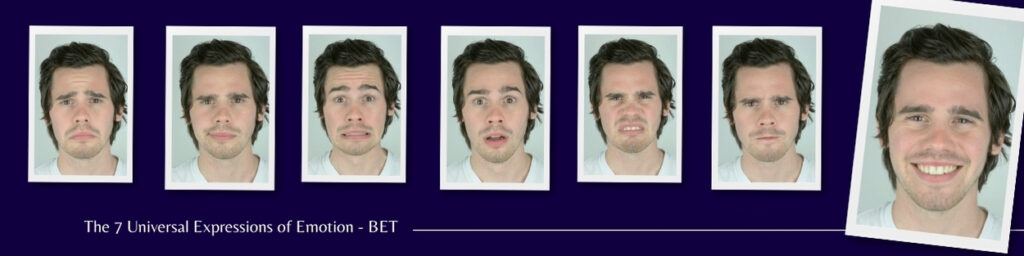
It is widely supported within the scientific community that there are seven basic emotions, each with its own unique and distinctive facial expression. These seven are:
Happiness, Sadness, Fear, Disgust, Anger, Contempt and Surprise.
Back in the late 1800’s Charles Darwin was the first person to suggest that facial expressions of emotion are the same wherever you go in the world, that they are innate. At the time, the majority of the scientific community disagreed with this theory.
It wasn’t until the late 20th century when Dr. Paul Ekman and his team did their research on the universality of facial expressions that we began to see substantial evidence that Charles Darwin’s theory was correct.
Dr. Ekman’s Early Research
 Paul Ekman
When Dr. Ekman began researching facial expressions of emotions across cultures, he initially had the opposite view to Charles Darwin. Ekman believed that expressions were socially learned, and therefore culturally variable. For instance, if you were born and raised in America, you would display very different facial expressions of emotion than if you grew up in Asia.
To finally put the argument to bed, Dr. Ekman set out on a research quest that would take him around the world to study the facial expressions of many different cultures to see if Darwin’s universality argument could be discredited.
The first cultures Ekman studied were based in the following countries – Chile, Argentina, Brazil, Japan and the United States.
Dr. Ekman’s initial study consisted of showing these groups of people photographs of individuals displaying different facial expressions of emotion. He would then ask the groups to judge what emotion they thought was being displayed in each photograph. The vast majority of the individuals from the five cultures agreed.
While this was a big step towards Darwin’s view that expressions of emotion are universal, Ekman was not fully convinced. He asked – ‘What if these five cultures had all grown up watching the same movies and tv shows’? Could it be that the reason they all agree is they have learned these expressions from the same place? Could the reason for their agreement be their similar background and experiences? Learned from media or actors, for example?
To test this theory, Ekman came up with a solution. Why not go and find a culture that has been completely isolated from the rest of the world. No TV, no magazines, no tourists? If facial expressions of emotion were learned from parents and teachers, then surely a stone-aged tribe would have an entirely different way of communicating emotion than those in western societies, right?
The Fore Tribe
 Fore Tribe in Highlands of Papua New Guinea
This lead Ekman to the highlands of Papua New Guinea to meet a remote, primitive tribe called the Fore. If the Fore tribe displayed and interpreted the facial expression of emotion the same as their western counterparts, we would have substantial evidence of the universality of facial expressions.
Equipped with a few simple stories and images of facial expressions, Ekman headed into the remote camp and asked each of the tribesmen/women to match a story to an expression.
Ekman prompted the tribesmen/women with three scenarios :
- “ The enemy approaches ” – They are Angry
- “ Friends have come ” – They are Happy
- “ A child has died ” – They are Sad
The tribesmen/women would then point to a photograph from a western face that they felt would most likely be displayed on the face of the person in the story. This was later reversed for westerners judging the Papua New Guinea faces.
Try it yourself…
Read each of the scenarios above, and then pick the picture below that you think best illustrates what would be on the face of the person in the story.


Have you done it?
If you thought…
- 1st Photo – The Friend story – Happy
- 2nd Photo – The Enemy story – Angry
- 3rd Photo – The Child story – Sad
Then you agree with most of those involved in the study.
Since Ekman’s pioneering study with the Fore tribe in 1969, countless other studies have supported his findings, and it is now widely accepted in the scientific community that Darwin was right and that facial expressions of felt emotions are universal.


