

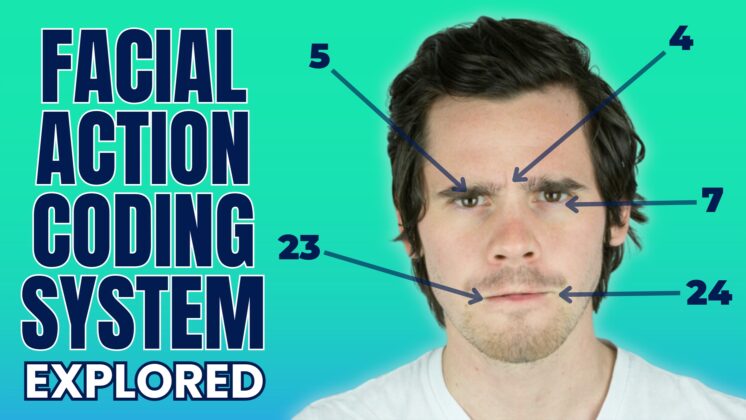
The Facial Action Coding System (FACS) is a globally recognised tool used to measure and analyse the full range of human facial expressions. Developed in the 1970s by psychologists Paul Ekman and Wallace V. Friesen, FACS provides a detailed framework for understanding how facial muscles contribute to the display of emotions. It remains the most widely used method for studying even the subtlest facial movements, helping to reveal the physiological presence of emotion with high reliability.
How Does FACS Work?
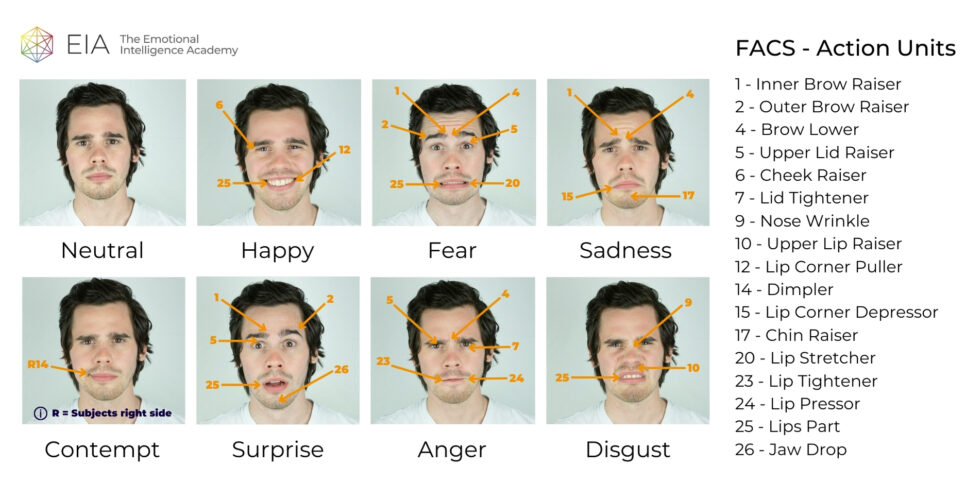
FACS breaks down facial expressions into smaller components called Action Units (AUs). Each AU represents the movement caused by the contraction or relaxation of specific facial muscles. For example, a smile might involve the action units associated with raising the cheeks and pulling the corners of the mouth upwards. By analysing these movements, experts can describe every facial expression in terms of intensity, duration, and symmetry.
Trained specialists use FACS to observe and interpret subtle changes in facial appearance, such as shifts in feature shape or skin texture. Understanding how action units correspond with specific expressions enhances our knowledge of human body language and non-verbal behaviour, which can be particularly useful in fields like negotiation, security, and healthcare.
The 7 Universal Facial Expressions of Emotion
FACS has been instrumental in identifying the seven universally recognised facial expressions of emotion: happiness, sadness, surprise, fear, anger, disgust, and contempt. These expressions are universally coded within FACS, which means they are consistent across all human beings, regardless of culture, gender, or age
The Applications of the Facial Action Coding System
One of the most notable applications of FACS is its ability to differentiate between genuine and fake expressions. For instance, it can distinguish a Duchenne smile (a genuine smile involving the muscles around the eyes) from a social smile (a polite or fake smile, typically involving only the mouth muscles). Understanding these nuances is invaluable in various professional contexts, such as interviewing, therapy, or customer service.
FACS is also widely used for measuring facial behaviour, identifying specific emotional expressions, and uncovering new patterns of facial movement. Its ability to detect these micro-expressions with high accuracy has made it a trusted tool in psychology, behavioural research, and even artificial intelligence, where it helps enhance the ability of machines to understand human emotions.
Why Choose FACS Over Other Systems?
FACS offers several advantages over other facial measurement systems. It is a comprehensive and unbiased method for documenting facial movements, allowing researchers and professionals to describe all observable behaviours or focus on emotion-specific actions. Moreover, it is non-intrusive, meaning that it can be applied without the subject being aware that their facial expressions are being analysed. This makes it particularly useful in real-world scenarios where natural behaviour is essential.

Evidence of FACS Effectiveness
Numerous studies have demonstrated the effectiveness of FACS in various contexts:
- Research by Ekman and colleagues has shown that FACS can support detecting deception, making it a valuable tool in law enforcement and security settings (Ekman, 2001; Ekman et al., 1988).
- Studies have also used FACS to predict coping mechanisms following traumatic loss (Bonnano & Keltner, 1997).
- Further research has explored its ability to forecast the onset and remission of mental health conditions such as depression and schizophrenia (Ekman & Rosenberg, 1997).
These findings underline the importance of FACS in psychological and medical research, as well as its applications in real-world settings like law enforcement and healthcare.
How Can FACS Work for You?
Understanding facial expressions is a powerful skill that transcends cultural, ethnic, gender, and age differences. Research has consistently shown that humans express emotions through facial expressions in similar ways, regardless of background. This ability to read facial changes is crucial for effective communication and can benefit anyone working in fields where understanding emotions is key.
Professionals trained in FACS can apply these skills in various domains. For example, those in interviewing and interrogation can gain insights into whether someone is being truthful or deceptive. Understanding non-verbal cues in business can enhance negotiations and improve client relations. Meanwhile, in sectors like law enforcement and security, detecting subtle facial movements can be critical in assessing threats or verifying information.
For more on how FACS and other emotional intelligence tools can enhance your professional practice, visit our training and development page.


