Be honest. When did you last fire off a reply you’d give anything to take back? A spicy email, a snippy comment in a meeting, a text you watched land with a thud the second it was sent. Don’t worry, you’re in good company. We’ve all been there.
Let me go first.
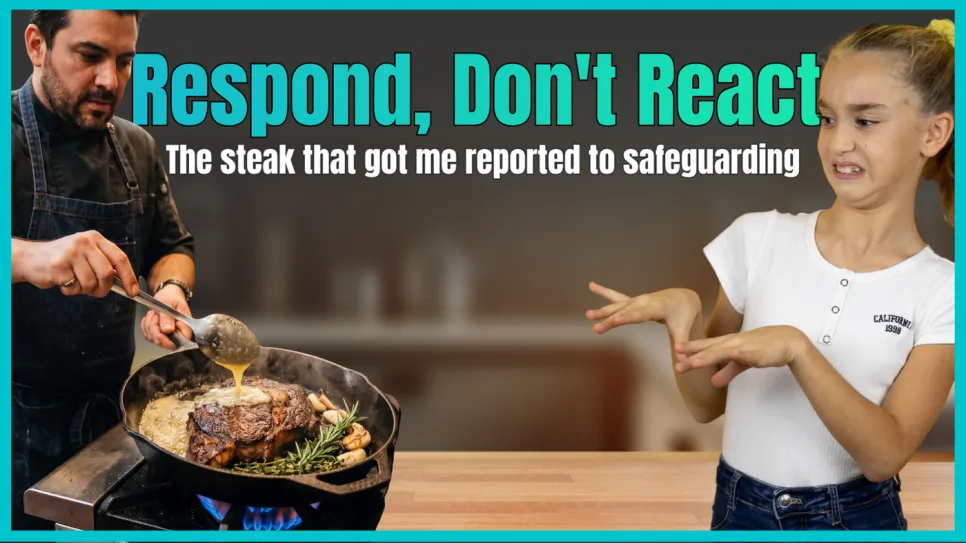
The steak that got me reported to safeguarding
A while back my seven-year-old turned into a fussy eater. Mealtimes became a greatest-hits tour of chicken nuggets, pitta and hummus, and, weirdly, salmon. Naturally I took full responsibility for none of it and blamed the picky kids at school. One afternoon I knocked off work early, grabbed her from the gates, and swung by the shops for a big juicy steak. Steak used to be our thing. I got home, nailed the medium cook just how she liked it, did some carrots and potatoes on the side, and presented it like a proud little chef.
“Ewww, I don’t like that.”
Now, she’s not a brat. She said it half playfully. But I could tell she meant it enough to sit and stare at the plate rather than eat a single bite. And here is where the gap showed up, that tiny pause between her words and my response. I sailed straight past it. Instead of taking a beat, I launched into a full diatribe. How bad it is to be picky. How good she used to be. How saying “ew” is disrespectful. Blah, blah, blah.
It did not work. She still didn’t fancy the steak. The only thing I’d achieved was making her sad by “telling her off,”… though our definitions of telling off differ wildly.
Fast forward a few days. I get a call from school. A safeguarding chat. Essentially to figure out whether I was emotionally damaging my child over dinner. Turns out my kid had told her teacher that “daddy gets very angry when I don’t eat.” A couple of details got, let’s say, creatively embellished. And there I was, sweating down the phone, mentally reviewing every word I’d said to her, feeling like a teenager hauled to the headteacher’s office.
Do I take full responsibility for that outcome? No. But there is zero doubt that my failure to take a breath, to respond to my kid instead of react, kicked off a downward spiral for both of us.
The little gap that changes everything
So here’s the thing. Between the trigger (her “ewww”) and my response (the lecture) there was a gap. It can be less than half a second. Most of the time we don’t even notice it. We fly straight from trigger to reaction and then spend the rest of the day living with whatever fell out of our mouths… or on a safeguarding call.
That gap is one of the most valuable assets you will ever own, in leadership and in life. There’s a line often credited to the psychiatrist Viktor Frankl: “Between stimulus and response there is a space. In that space is our power to choose our response.” That space is the whole game. The leaders who stay annoyingly calm under pressure aren’t feeling less than you. Their chests tighten and their jaws clench too. They’ve just learned to notice the gap and use it. They put a beat between what happened and what they do next, and in that beat they choose a response on purpose, rather than react with whatever’s bubbling up.
This is the real difference between responding and reacting. A reaction is automatic, emotional, and usually about you. A response is chosen, intentional, and aimed at the outcome you actually want.
Why it feels impossible in the moment
There’s a reason this is so hard. When something triggers you, the emotional part of your brain (the amygdala) can fire before the thinking part has even shown up for work. Joseph LeDoux called it the “amygdala hijack.” Your body is halfway to a reaction before your rational brain gets a vote. So responding instead of reacting isn’t about being a wet blanket or stuffing your feelings down. It’s about buying your better judgment enough time to arrive. That is emotional regulation in a nutshell, and it’s a skill, not a personality trait.
What I actually do in the gap
Good news, you can train this. Here are the two moves I genuinely use when the heat rises and I can feel it in my chest and jaw.
One, I leave the room. Yep. Sometimes it looks a bit soft. I don’t care. If you’re not in the room, you can’t bite back. And if it’s really important, I’ll go and have a shower. Ten or fifteen minutes of warm water to let the rage wash off, and then I use the time to actually think. What’s the other person’s perspective? What might have really sparked this off? Where are my own biases and blind spots hiding? By the time I’m dry, I know how I want to handle the next conversation.
Two, when I can’t physically leave, I leave mentally. Just for a moment I float up and take a bird’s-eye view of the whole scene, like a therapist watching two clients. I park my ego, look down on what’s happening, and try to work out where each person is actually coming from and where the confusion or the disagreement really sits. Sounds like it would take forever. On a good day I can do it in under thirty seconds. And if I can’t get all the way there, I at least suspend the judgment and swap it for a genuinely curious question to get more information.
These aren’t the only options. Some people use box breathing. Some self-soothe by literally stroking their own arm to settle the nervous system. It comes down to personal preference, so try a few and keep whatever works for you.
Where you actually need this: the shit boss
You might be reading this thinking, lovely story about a steak, but where do I actually need it? Here’s my bet. A shit boss.
We’ve all had one. Plenty of you have one right now. The kind who got promoted for time served rather than talent, who refuses to learn anything new because the old way ‘works fine,’ and who needs everyone kept ‘below’ them so they can hoover up the credit. Inflated ego, a real appetite for putting people down, and a special talent for ignoring the strengths sitting right there on their own team. And these arseholes are absolutely everywhere.
Here’s the brutal bit. You cannot control whether your boss is a knob. You can only control the gap between what they do and how you respond. Every time they bait you, move the goalposts, or take a cheap shot in front of the team, they are handing you a trigger. React, and you’ve handed them the exact story they wanted. Respond, and you stay the calm, credible one in the room while they’re the one losing it. That, repeated over months and years, is how you quietly become the leader people actually want to follow.
The bit nobody wants to hear
People think managing your emotions is something for hippies, therapists, and monks. That’s a cop-out. A neat little excuse not to learn a skill you can’t inherit and can’t cheat. The only way to get good at the gap is hard graft, honest reflection, learning from your screw-ups, and practising again and again. Because if you let your emotions run the show even when they are flat-out wrong for the moment, you’re not being passionate or authentic. You’re being a crybaby.
Most of the time, the pause alone changes what you do. And sometimes, once you’ve actually thought about it, your first instinct turns out to be the right one, so you commit to it fully and with intent. The difference is that this time you chose it.
Want to get properly good at it?
Getting good at the gap starts with understanding how you’re wired in the first place. That’s exactly why we built The Behavioural Edge: to help you understand how you naturally behave, then hand you the tools to manage and steer that behaviour towards what you actually want. So your emotions stop dragging you along for the ride, and you take the wheel instead.
Or just start with the shower. Your call.
Stay groovy,
Harry Lansley,
Co-founder, EmotionIntell