
Abstract:
The term ‘competence’ has become increasingly ambiguous, often conflated with attitudes, personality traits, or values rather than being clearly linked to demonstrable ability and performance. This white paper proposes a new definition of competence, leveraging the KUSAP™ model – Knowledge, Understanding, Skills, Application, and Performance – offering a progressive, assessable framework grounded in observable capability that can be applied to any discipline or field.
Rooted in Bloom’s Taxonomy and refined through practical application in human performance and emotional intelligence (EI) assessment, KUSAP™ distinguishes competence from dispositional traits. It provides a pathway from conceptual knowledge to embedded professional performance. The model is proposed as a standard for educational design, assessment frameworks, recruitment processes, and membership criteria in professional bodies.
Introduction: The Competence Conundrum
In academic, educational, and organisational contexts, the term ‘competence’ is frequently used but rarely defined with precision. Over time, it has come to encompass not just abilities, but traits, attitudes, motivations, and even values. Such ambiguity has diluted its practical utility, making it difficult to assess, teach, or credential competence objectively. This reality is clear from the authors own doctorate research around emotional intelligence where there was significant agreement across the global the subject matter experts (researchers and practitioners… not just academics) that the core of a model designed to assess and develop emotional intelligence should be focused on ability, and not be contaminated with attitudes, personality traits, or values and other subjective preferences and styles.
There is a clear need for a more rigorous and performance-based definition. In response, this paper introduces the KUSAP™ framework as a restructured taxonomy of competence, grounded in demonstrable progression and applicable across disciplines.
Historical Roots and Taxonomies
The Oxford Learners Dictionaries simply define competence as ‘the ability to do something well’. In the professional world, certainly in leadership and early emotional intelligence models the root of the frameworks often can be traced back to David McClelland (1953) and Spencer and Spencer (1993).
The roots of KUSAP™, created by the author, can be traced to Bloom’s Taxonomy (1956), which defined learning objectives in the cognitive domain as progressing from knowledge to comprehension, application, analysis, synthesis, and evaluation. This hierarchy has shaped decades of curriculum design and assessment. It should be noted that Bloom’s taxonomy of measurable verbs has an educational (rather than wider performance) focus “intended to provide for classification of the goals of our educational system” (ibid:1) and it did not include traits, attitudes or values; nor did it extend beyond the educational curriculum context into performance in work, life, sports and other contexts. Later frameworks such as KSA (Knowledge, Skills, and Abilities) in occupational psychology attempted to bridge education with job performance. Yet they often remained limited by the lack of clarity around real-world application and sustainable performance.
KUSAP™ refines this progression by clearly segmenting the pathway from awareness to expertise, making it possible to define and assess competence without conflating it with innate characteristics or traits.
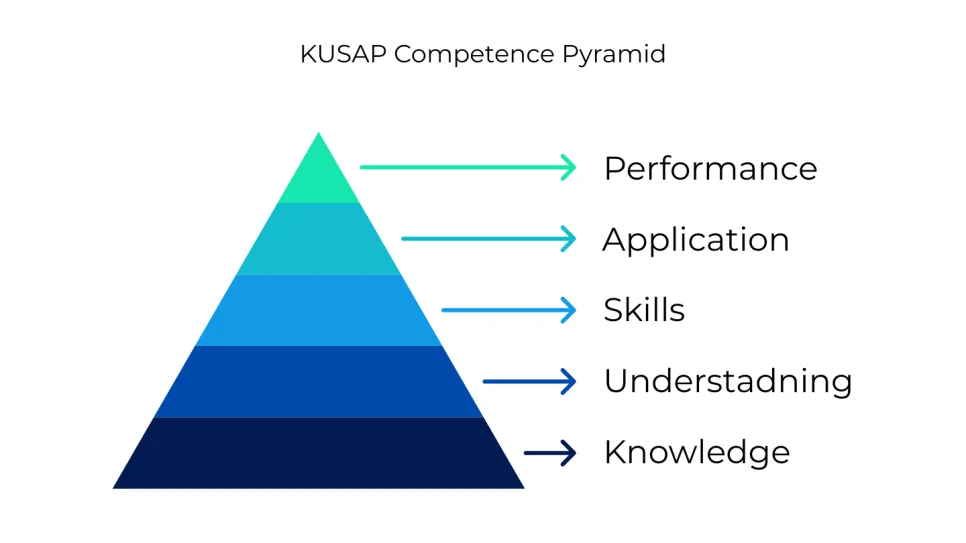
Defining Competence Using KUSAP™
I therefore propose the following definition to encompass this wider taxonomy:
Each stage of the KUSAP™ taxonomy builds on the last, establishing a cumulative foundation for authentic competence. This excludes personality traits, attitudes, or values, which are often stable dispositions and not readily teachable or assessable in structured learning environments.
| KUSAP® | Definition | Example Evidence |
|---|---|---|
| Knowledge | Factual recall of facts, concepts or procedures. | Multiple choice/response questions, definitions, lists |
| Understanding | Conceptual grasp and ability to explain processes. | Essays, diagrams, case reflections |
| Skills | Operational techniques under structured conditions. | Simulations, role plays, analytical observation |
| Application | Adaptation and contextual use in realistic scenarios. | Situational Judgement Tests(SJT), case studies, reflective logs, supervisor reports |
| Performance | Sustained, embedded, effective execution in real-world contexts appropriate to the performance context (work/social/home/life). | 360 feedback, peer ratings, outcome data |
The knowledge and understanding (and skills) should not be ignored as these elements enable individuals to transfer their application and performance across a range of real-world contexts, rather than the specific contexts or simulations that may have been used in development and assessment stages. This is about competence being sustainable and transferrable over time and across places, whether stakes are low or high, and even into other disciplines of fields. Context is where traits feature – competent people will be able to remain ‘competent’ when dealing with individuals across the range of personality, cultural and other individual differences they are likely to face.
Applications to Emotional Intelligence and Human Performance
The KUSAP™ framework is particularly wellsuited to the field of emotional intelligence (EI), where traditional models have often struggled to balance the measurement of observable behaviours with the complexity of internal emotional processes. By applying KUSAP™, we can map a learner’s journey from basic emotional awareness to consistent, skillful, emotionally intelligent practice and leadership.
In EI education and assessment, this means:
- Developing cognitive understanding of emotional triggers and patterns (Understanding),
- Practicing skills like empathy, reading multichannel cues, reframing, active listening, and assertiveness (Skills),
- Applying those skills in authentic relational contexts (Application),
- Demonstrating mastery through real-time emotional regulation, resilience, relational influence, or coaching others (Performance).
For performance environments such as education, healthcare, law enforcement, or leadership, KUSAP™ enables structured capability development and reduces reliance on vague ’emotional maturity’ criteria and self-report perception. This strengthens both equity and accountability in EI development programs.
Benefits of Adopting the KUSAP™ Definition
KUSAP™ addresses several persistent issues in how competence is defined and assessed:
- It separates teachable capabilities from personality traits.
- It provides clear, progressive learning stages that can be assessed.
- It enables robust curriculum and credential design.
- It supports greater rigour in emotional intelligence education and training
- It aligns competence with observable, role relevant outcomes rather than abstract ideals.
In addition, for professional regulation purposes, KUSAP™ supports evidence-based accreditation systems for professional bodies and institutes by providing a transparent structure for membership levels, certifications, and continuing professional development (CPD).
Next Steps
The following steps are underway to integrate the KUSAP™ definition of competence into educational and professional systems:
1. Adopting the KUSAP™ definition as a standard in curriculum frameworks and learning design.
2. Aligning assessment rubrics with KUSAP™ stages for transparent progression.
3. Developing micro-credentials or badges aligned to each KUSAP™ level.
4. Establishing professional membership criteria using KUSAP™ -based evidence.
5. Promoting further research into KUSAP™ -aligned assessments across sectors.
Cliff Lansley PhD
January 2026.
References
Anderson, L. W., & Krathwohl, D. R. (2001). A taxonomy for learning, teaching, and assessing: A revision of Bloom’s taxonomy of educational objectives. Longman.
Bloom, B. S. (1956). Taxonomy of educational objectives: The classification of educational goals. Handbook I: Cognitive domain. David McKay.
Boyatzis, R.E., (1991). The competent manager: A model for effective performance. John Wiley & Sons.
Chouhan, V.S. and Srivastava, S., (2014). Understanding competencies and competency modeling―A literature survey. IOSR Journal of Business and management, 16(1), pp.14-22.
Eraut, M. (1994). Developing professional knowledge and competence. Routledge.
Goleman, D. (1995). Emotional intelligence: Why it can matter more than IQ. Bantam Books.
Lansley, C. (2020) Emotionintell: a generic Emotional Intelligence model. https://espace.mmu.ac.uk/view/creators/Lansley=3ACliff=3A=3A.html (accessed January 2020)
OxfordLearnersDictionaries https://www.oxfordlearnersdictionaries.com/definition/american_english/competence#:~:tex t=1(less%20frequent%20competency)%20%5B,Check%20pronunciation:%20competence (accessed January 2026)
Spencer, L. M., & Spencer, S. M. (1993). Competence at work: Models for superior performance. Wiley.
Winterton, J., Delamare-Le Deist, F., & Stringfellow, E. (2006). Typology of knowledge, skills and competences: Clarification of the concept and prototype. CEDEFOP.
Ready-made references.
Lansley, C. (2026). Redefining Competence: A new definition and taxonomy for competence that aims to drive human performance [White paper]. EmotionIntell. https://www.emotionintell.com/white-paper/redefining-competence-a-new-definition-and-taxonomy-for-competence-that-aims-to-drive-human-performance/
Lansley, C. (2026) Redefining Competence: A new definition and taxonomy for competence that aims to drive human performance. EmotionIntell. Available at: https://www.emotionintell.com/white-paper/redefining-competence-a-new-definition-and-taxonomy-for-competence-that-aims-to-drive-human-performance/ (Accessed: 16 October 2026).
@techreport{lansley2026redefining,
  author      = {Lansley, C.},
  title       = {Redefining Competence: A new definition and taxonomy for competence that aims to drive human performance},
  institution = {EmotionIntell},
  type        = {White paper},
  year        = {2026},
  url         = {https://www.emotionintell.com/white-paper/redefining-competence-a-new-definition-and-taxonomy-for-competence-that-aims-to-drive-human-performance/}
}
Please link to this page rather than the PDF, so readers always reach the latest version.