









WHY STATEMENT ANALYSIS MATTERS
We are bombarded with statements. Very few of us know how to assess them.
Every day, professionals make critical decisions based on what people tell them. A witness account. A candidate’s interview response. A partner’s business proposal. A suspect’s alibi. A politician’s claim. A colleague’s explanation for a missed deadline.
Yet research consistently shows that untrained individuals perform barely better than chance at distinguishing truthful statements from fabricated ones. Most people rely on gut instinct, folk wisdom, or discredited “tells” approaches that simply don’t hold up under scientific scrutiny.
The consequences of getting it wrong range from hiring the wrong candidate to wrongful convictions. Statement analysis gives you a structured, evidence-based framework to assess what you’re being told, replacing guesswork with rigorous methodology.
COURSE INTRODUCTION
Do you want to discern truth from falsehood in any statement?
This intensive 1-1 coaching programme equips you with that vital skill. By the end, you’ll be able to confidently assess the credibility of any account of an event, using a structured, evidence-based methodology that holds up under scrutiny.
We focus on Criteria-Based Content Analysis (CBCA), the most robust and scientifically backed method in the field. Forget the questionable techniques you may have seen before. This programme teaches you what actually works. Expect to develop the skills, knowledge, and confidence to expertly analyse any statement and determine its veracity.
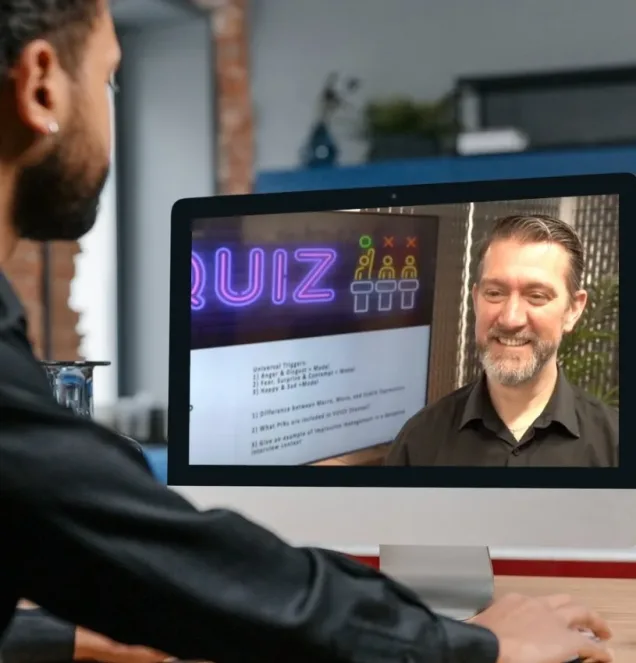
Unlike a group workshop, this programme gives you 100% of your tutor’s attention. Every coding decision you make gets scrutinised. Every question gets answered. Every exercise is tailored to your professional context. And the whole thing is scheduled around your diary.
THE 1-1 ADVANTAGE
Your 1-1 Coaching
- Sessions are arranged entirely around your diary
- Content paced and pitched to your level
- 100% tutor focus. Every minute is for you
- Practice exercises tailored to your professional context
- Line-by-line feedback on every coding decision
- Direct application to the types of statements you encounter daily
LEARNING OUTCOMES
What you’ll be able to do after this programme
By the end of your 8 hours of coaching, you will have the skills, knowledge, and confidence to systematically analyse any statement and assess its credibility.
Apply CBCA Systematically
Identify and code all 19 CBCA criteria with confidence, producing structured credibility assessments of any verbal statement.
Distinguish Credibility from Truthfulness
Understand the critical distinction between whether a statement is credible and whether it is factually true. A nuance most practitioners miss entirely.
Analyse Real Statements
Work through real-world statements with expert guidance, receiving personalised feedback on your coding accuracy and analytical reasoning.
Use Complementary Techniques
Go beyond CBCA with additional analytical approaches — including Reality Monitoring criteria, to build a more comprehensive evaluative toolkit.
Adapt to Your Professional Context
Learn to apply the methodology appropriately across different professional settings, from investigative interviews to HR processes to commercial negotiations.
Produce Analytical Reports
Master the full process from recording an initial statement through to writing detailed, defensible analytical reports of your findings.
WHO IS THIS FOR
If the credibility of a message matters in your role, this programme was built for you
Statement analysis isn’t limited to law enforcement. Any professional who needs to evaluate what people say and decide how much weight to give it will find this programme immediately applicable.

Investigators & Law Enforcement
Interview analysis, witness credibility assessment, suspect statement evaluation, case file preparation. Build the skills to identify credibility indicators that can guide the direction of an investigation

Intelligence & Security
Source debriefing analysis, threat assessment statements, security screening conversations. When you're assessing information from human sources, CBCA provides a framework to evaluate what you're being told.

Legal Professionals
Witness preparation, deposition analysis, courtroom testimony evaluation, expert opinion development. CBCA is used in courts across Europe as the basis for forensic credibility assessments.

HR & Recruitment
Internal investigations, disciplinary statement review, interview assessment, whistleblower account evaluation. Make more informed decisions about the accounts you receive as part of people processes.

Journalists & Media
Source verification, interview analysis, editorial integrity. In an era of misinformation, having a structured framework to assess the credibility of what sources tell you is an invaluable professional asset.

Business & Commercial
Negotiation insight, partner due diligence, insurance claim evaluation, sales conversations. When the stakes are high and you need to assess what you're being told, statement analysis provides a structured edge.
PROGRAMME CURRICULUM
Eight hours of structured, expert-led content
Each module combines theory, demonstration, and hands-on practice. Your tutor tailors the pace, depth, and examples to your professional background and learning goals.
Foundations of Statement Analysis
Explore the historical development of statement analysis from its origins in German forensic psychology. Understand the Undeutsch Hypothesis, how CBCA emerged from Statement Validity Assessment (SVA), and why it has become the most widely used credibility assessment tool worldwide. You’ll also examine the critical distinction between credibility and truthfulness, and why confusing the two is one of the most common mistakes practitioners make.
The Statement Analysis Process
Walk through the end-to-end statement analysis workflow: from how a statement should be recorded (the concept of ‘pure statements’ and why this matters), through initial reading and segmentation, to detailed coding and final report writing. You’ll understand what constitutes an analysable statement and common pitfalls that compromise analysis quality before you even begin.
CBCA Criteria: Deep Dive (Part 1)
Systematically work through the first three CBCA categories — General Characteristics, Specific Contents, and Peculiarities of Content. For each criterion, your tutor will explain what to look for, demonstrate with worked examples, and discuss the cognitive and motivational theory behind why these features appear more frequently in genuine accounts.
CBCA Criteria: Deep Dive (Part 2)
Continue with the Motivation-Related Contents and Offence-Specific Elements categories. Explore the more nuanced criteria — spontaneous corrections, admissions of memory gaps, self-deprecation — and discuss the research on which criteria have the strongest discriminative validity. You’ll also explore the Validity Checklist and how it contextualises your CBCA findings.
Guided Practice: Coding Real Statements
Apply what you’ve learned to sample statements drawn from real-world contexts. Work through each statement independently, then review your coding with your tutor line by line. This is where the 1-1 format proves its value — every coding decision gets scrutinised and discussed, with personalised feedback on your reasoning and accuracy.
Complementary Analytical Techniques
CBCA doesn’t exist in isolation. Explore additional approaches that complement your statement analysis toolkit — including Reality Monitoring criteria, Scientific Content Analysis (SCAN) comparisons, and linguistic analysis techniques. Understand the strengths and limitations of each method and when to combine approaches for more robust assessments.
Context-Specific Application
Adapt the statement analysis process to your professional environment. Whether you work in law enforcement, HR, intelligence, journalism, or business, your tutor will help you understand how context affects both the statements you’ll encounter and the appropriate application of CBCA criteria. Work through scenarios relevant to your specific role.
Assessment, Q&A, and Next Steps
A final guided assessment where you independently analyse a statement under tutor supervision, demonstrating your competence across the full CBCA framework. Then an open Q&A to address remaining questions, discuss challenges, and plan your continued development, including pathways into EmotionIntell’s broader SCAnS training ecosystem.
YOUR COACHING TEAM
Learn from world-leading practitioners
Your coaching is delivered by EmotionIntell’s specialist tutors – each with deep expertise in behaviour analysis, credibility assessment, and the CBCA methodology.

Aaron Garner
Expert in Six Channel Analysis and a leading figure in communication and behaviour analysis. Aaron is the Programme Leader for EIA's MSc in Communication, Behaviour, and Credibility Analysis — delivered in partnership with Manchester Metropolitan University. He designs and delivers programmes supporting real-time truth and deception assessment, working with Military and Special Forces, European Intelligence Services, Venture Capitalists, Negotiators, and airport security personnel across the globe. His co-authored research with Dr Lansley has been published in The Routledge Handbook of Language in Conflict.

Dr Cliff Lansley
A pioneer in behaviour analysis with over 30 years' experience applying his research across governmental, military, and commercial organisations worldwide. He served as a partner of Dr Paul Ekman for 10 years, is the Scientific Advisor to Warner Bros/Discovery Channel's 'Faking It: Tears of a Crime' (now in its 6th series), and has led coaching and seminars for over 10,000 professionals from the military, intelligence, law enforcement, finance, and business sectors.
THE EVIDENCE BASE
A methodology backed by decades of peer-reviewed research
CBCA isn’t a trend; it’s the most extensively validated credibility assessment method in forensic psychology, with 40+ years of peer-reviewed research behind it. Developed for use in criminal courts, refined through multiple meta-analyses, and accepted as evidence across European legal systems, this is what professionals use when accuracy isn’t optional.
Many statement analysis approaches exist. Most lack serious scientific validation. We teach CBCA because it was built and tested in forensic settings where getting it wrong has real consequences – and because it works.
Within EmotionIntell’s broader SCAnS system, CBCA sits alongside 26 other truth/deception indicators across six channels of communication. This programme gives you mastery of the verbal content channel – the foundation that everything else builds on.
EARN A RECOGNISED CREDENTIAL
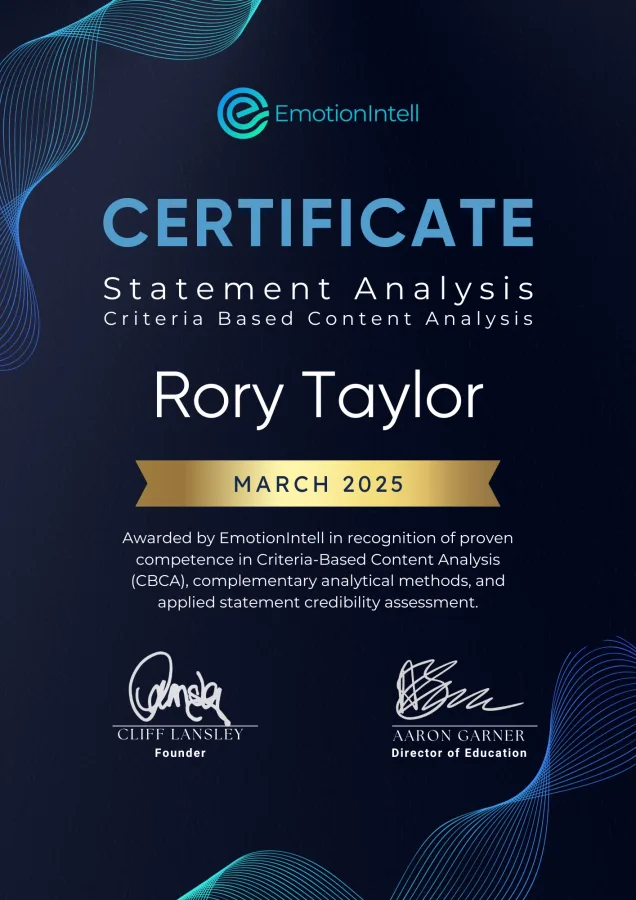
Complete the programme and receive a certified certificate from EmotionIntell, evidencing your trained competence in Criteria-Based Content Analysis and statement credibility assessment. Recognised across law enforcement, intelligence, legal, HR, and business sectors worldwide.
HOW IT WORKS
Your coaching, your schedule — here’s how it comes together
Eight hours of expert-led, personalised coaching, divided into sessions that fit your work and life commitments. No fixed dates. No need to clear your diary for a solid block.
1
Book Securely Online
Complete your purchase through our secure checkout. Your place is instantly confirmed with a receipt and welcome email.
2
We Get in Touch
Within 24 hours, our team contacts you to understand your availability, your role, your objectives, and how you’d like to structure your sessions.
3
Personalised Schedule
Together, we design a training timetable that works for you. Most participants choose 2-hour sessions across several weeks, but half-day or full-day intensive formats are available too.
4
Begin Your Coaching
Sessions are delivered live via video by your dedicated tutor. Eight hours of focused, one-to-one training with personalised feedback on your analytical work.
BOOK YOUR PLACE
Invest in a skill you’ll use every day
Secure your 1-1 coaching below. After booking, our team will be in touch within 24 hours to design your personalised training schedule.
8 Hours of Expert Coaching
Personalised, flexible scheduling to fit around your professional and personal commitments. Delivered live via video by EmotionIntell’s specialist tutors.
- 8 hours of dedicated 1-1 coaching with an expert tutor
- Flexible scheduling — split across sessions that suit you
- Full CBCA methodology and complementary techniques
- Hands-on practice with real statements and personalised feedback
- Course materials and post-coaching resources included
- Pathway into EmotionIntell’s broader SCAnS training ecosystem

